Is Shopify Still the Best Choice for Your E-Commerce Store?
Shopify Review 2026: 7 Crucial Pros & Cons for E-Commerce
Launching an online store often comes down to choosing the right foundation. If you are researching platform options, this in-depth Shopify review breaks down everything you need to know before investing your time and money. Platforms like WooCommerce, BigCommerce, and Squarespace each serve distinct niches, but Shopify continues to dominate the direct-to-consumer landscape.
Whether you are launching your first retail venture or migrating an established brand, this Shopify review explores the platform’s core strengths, practical limitations, and whether it fits your specific business model.
What Makes Shopify the Industry Standard?
Shopify’s standing as the market leader is built on reliability and operational convenience. Building a self-hosted e-commerce site typically requires configuring hosting environments, provisioning SSL certificates, setting up database tables, and monitoring server resources during unexpected traffic spikes. Shopify absorbs that entire backend burden as a fully managed SaaS platform.
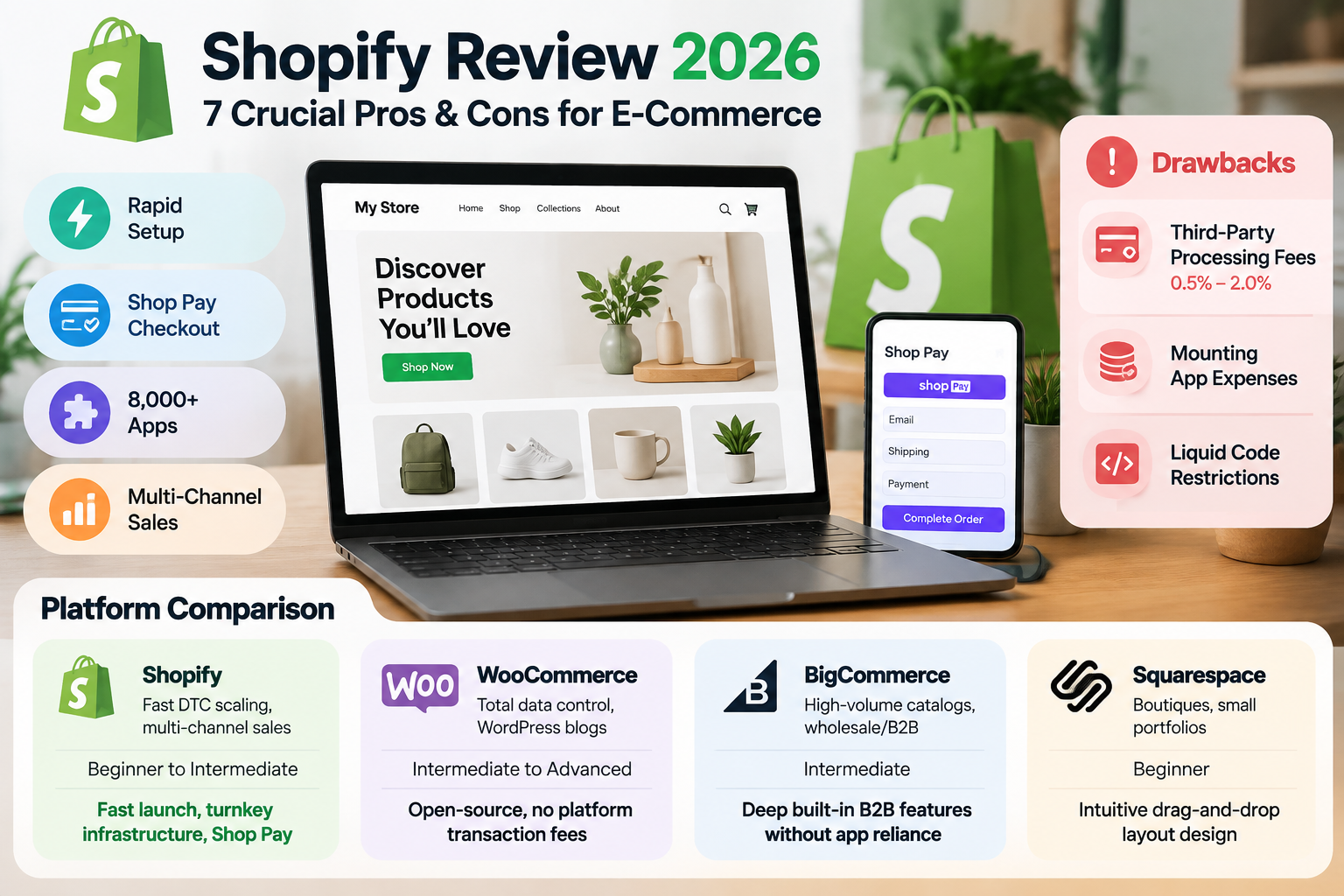
- Rapid Setup: You can transition from an idea to an active checkout system in an afternoon without technical knowledge or custom code.
- Optimized Checkout Experience: The proprietary one-click checkout, Shop Pay, delivers industry-leading transaction completion rates by cutting checkout friction for millions of repeat shoppers across the network.
- A Massive App Ecosystem: With more than 8,000 apps available in the app marketplace, you can expand functionality at will—incorporating subscription programs, recurring orders, automated email marketing funnels, and real-time inventory synchronization.
- Integrated Multi-Channel Sales: Native integrations let you synchronize inventory across brick-and-mortar locations via Shopify POS, TikTok Shop, Instagram Shopping, and external platforms like Google Merchant Center directly from a unified control panel.
The Hidden Drawbacks: 3 Core Trade-Offs
No software platform meets every operational requirement. While writing this Shopify review, three significant friction points stood out:
- Third-Party Processing Surcharges: Unless you process payments through Shopify Payments, the platform adds an extra processing fee ranging from 0.5% to 2.0% to each customer order.
- Mounting App Expenses: Although the base subscription plans are straightforward, many essential features—such as custom product configurators, wholesale portals, and advanced visual builders—require paid monthly extensions that inflate operational overhead.
- Liquid Code Restrictions: While Shopify’s Liquid template language offers clean styling tools, building bespoke templates or deeply customized shopping carts often demands custom developer hours or a shift toward a headless setup.
Platform Comparison: How Shopify Stacks Up
| Platform | Best For | Technical Skill Needed | Key Advantage |
| Shopify | Fast DTC scaling, multi-channel sales | Beginner to Intermediate | Fast launch, turnkey infrastructure, Shop Pay |
| WooCommerce | Total data control, WordPress blogs | Intermediate to Advanced | Open-source, no platform transaction fees |
| BigCommerce | High-volume catalogs, wholesale/B2B | Intermediate | Deep built-in B2B features without app reliance |
| Squarespace | Boutiques, small portfolios | Beginner | Intuitive drag-and-drop layout design |
For an in-depth breakdown of self-hosted alternatives, check out our internal guide to e-commerce platforms.
Is Shopify Right for Your Store?
Before signing up for a plan, evaluate these critical questions:
- What is your catalog size? For stores featuring fewer than five artisan items alongside an editorial publication, a simple website builder may be enough. For multi-variant collections with dozens of SKUs, Shopify’s catalog manager provides vastly superior stock tracking.
- Is Shopify Payments available in your region? Review the list of supported territories on the official Shopify website to ensure your company avoids third-party gateway penalty fees.
- Do you have dedicated technical support? Teams without in-house web engineers generally prefer Shopify because automatic platform updates, server patches, and payment security compliance are managed automatically.